Thursday, May 1, 2014

Yay for Spring! GARDEN SONG / PETE SEEGER


Yay!
The APRIL
showers have brought the May flowers!
Take
some time this week to stop and smell the flowers~ALL of them!


Thursday, April 3, 2014

Spring, Bunnies, Rainbows, & Easter~What Could Be Better?

I can happily report that spring has definitely arrived on the mid-Atlantic coast. Signs of spring are everywhere—from the bluebirds that are busily creating their nests, to the flowers popping up from the still-frosty ground, to the trees that look as if their branches are ready to burst. Spring is my favorite season, ushering in the opportunities to renew just about everything.

For Quiet Bunny, the adorable creation by Lisa McCue, the same is true. Quiet Bunny loves spring. And, as Easter falls this month, I decided to offer a review of Quiet Bunny’s Many Colors—a book perfect for spring AND Easter!
QUIET BUNNY’S MANY COLORS by Lisa McCue
From yellow to green and from blue to red—Quiet Bunny loves all of the colors of spring. Yet, poor Quiet Bunny becomes sad when he thinks that his brown and white fur is not a color of the season that he loves so much.

Quiet Bunny sets out on a mission to become one-with-spring by adorning himself with nature’s offerings of the season.
He tries dandelions.
He tries lily pads.
Quiet Bunny even tries a good coating of red clay.
Nothing works.

Just about the time that Quiet Bunny is ready to give up a wise owl steps in and helps Quiet Bunny realize that he is indeed the color of spring!
In Quiet Bunny’s Many Colors, Lisa McCue, author and illustrator, presents a heartwarming tale of acceptance of oneself. With vivid splashes of color, McCue’s illustrations will definitely create a lasting memory of this very important message. Her clever way of transitioning from one event to the next also provides an opportunity to discuss sequencing and story plots.
As an added bonus, McCue tucks little surprises on each brightly colored two page spread that will encourage children to explore the world around them. Children will delight in finding each plant and animal that represents the color that Quiet Bunny is attempting to mimic.

Bunnies, nature, bright colors, and acceptance of our many differences—Quiet Bunny’s Many Colors is the perfect way to usher in the season of new beginnings.

Word Count: 609
Average words per page: 20
Recommended Age: 3-6-years-old

Added bonus: Great for color recognition, identifying items from nature, and lessons on acceptance, FABULOUS illustrations!


Click here for a link to Lisa McCue's story-Quiet Bunny's Many Colors


Fun Printables to Teach Color Recognition and Sequencing


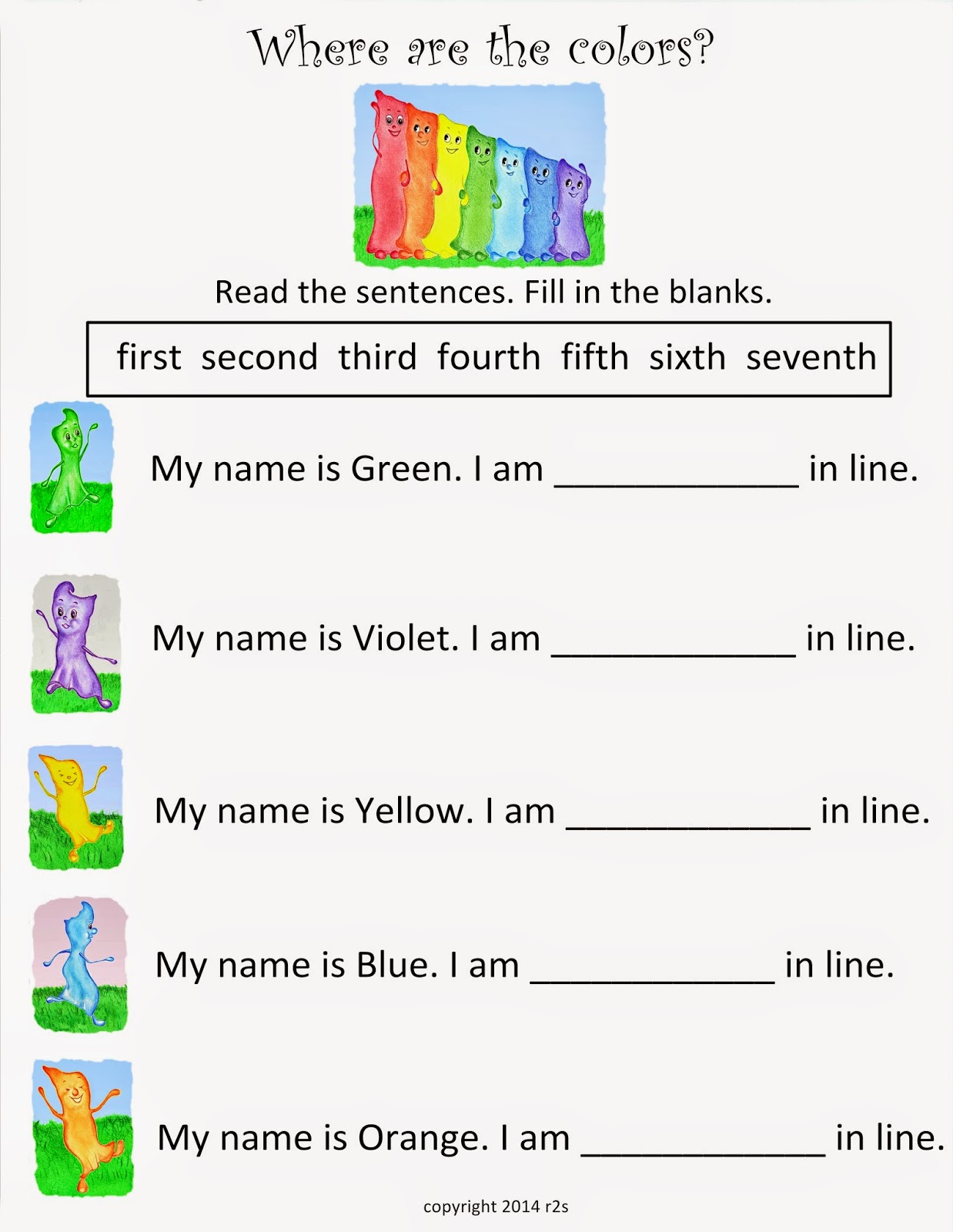
If you are seeking additional resources to teach and reinforce color recognition, my newest book When Violet was Blue, available as an ebook on Amazon can easily fit the bill. The simple drawings and bouncy tale will help your little ones learn and remember the colors of the rainbow.
The image below will lead you to a link of the ebook. This book even features the text-to-speech option so that your little ones can ‘read’ the story all by themselves.
 
http://www.amazon.com/When-Violet-Was-Blue-Troehler-ebook/dp/B00JAN76PK/ref=sr_1_1?ie=UTF8&qid=1396529609&sr=8-1&keywords=when+violet+was+blue
Link to ebook on Amazon


Monday, March 10, 2014

RAINBOW Fun for St. Patrick's Day

Here on the east coast, the winter has definitely been long. Students in our area missed nearly 3 weeks of school due to snow, ice, wind—you name it. That’s why I am especially looking forward to St. Patrick’s Day this year. The holiday doesn’t always attract much attention. However, with the sea of green from a St. Patty's Parade and the rainbows that signal the end of a storm, St. Patrick’s Day seems to be the perfect holiday to usher in a spring-thinking state of mind.

The post for today deals with the wonders of a rainbow and a quick list of activities that you can use to reinforce math skills as well as color identification.
So, print the printables and have some rainbow fun.

RAINBOW STICKS
This printable is great for teaching color concepts, ordering of sizes, and non-standard measurement (How many red strips long is the table?)

Suggestion: Print the color sticks on card stock. If you decide to use these to teach fact families, cut off the white end of each stick.
RAINBOW BRICK COUNTING STICKS
 
This printable is great for teaching addition basic facts, comparisons, and matching.
Suggestion: Print the color sticks on card stock. If you decide to use these to teach fact families, cut off the white end of each stick to more easily align each stick.

RAINBOW ADDITION
 
Create your own rainbow with pipe cleaners or wax-coated yarn to demonstrate differences in diameter.


If you are looking for a fun story that teaches colors, positional words, and the concept of teamwork to the kiddos, check out the link below to my latest story for children ages 3 through 6.


http://www.amazon.com/When-Violet-was-Blue-Troehler/dp/149612958X/ref=sr_1_1?ie=UTF8&qid=1398776065&sr=8-1&keywords=when+violet+was+blue
Link to Book and eBook on Amazon.com

Most importantly, have some RAINBOW FUN.
Happy St. Patrick’s Day!

This post was shared on the following blog. Please check them out:

The Kennedy Adventures dot Com


Monday, February 10, 2014

How Can You Teach RATIOs with Snow?

Winter definitely continues to grasp many areas of North America. And, just like my family, I am certain that your family is eager for blustery spring winds to blow away those pesky snow clouds.
Hopefully, it won’t be too long before the light and fluffy snowflakes will be replaced by an ample supply of raindrops—the perfect way to wash away the gray of winter.
This anticipation of spring is a great opportunity to provide not only a science lesson but also a fun way to demonstrate the concept of ratios. By using the relationship between snowflake density and raindrop density (i.e. the Snow Water Equivalent), the kiddos can practice using ratios, skip counting, and multiplication.
Why not go outside, scoop up a bucket of fresh fallen snow, and have some winter-spring transition fun.
HOW CAN WE USE THE SNOW WATER EQUIVALENT TO TEACH RATIOS?
“IT’S A RATIO.”
“HORATIO WHO?”
Every time I hear the term ratio, I recall the scene where Opie and Andy Taylor discuss ratios. Opie, most likely in the first grade, does not understand the term. In fact, many children in K-2 have difficulty grasping the concept. Add this confusion to the concept of comparing snowfall amounts with rainfall amounts, and you have a recipe for a flood of misunderstanding.
This activity addresses both concepts in a fun yet scientific manner. Finish it off with a snow cone treat and your children are bound to forever remember that it takes a lot of snow to equal an inch of rainfall!
ACTIVITY DESCRIPTION: Children will observe changes in density by melting snow. They will then use the melted snow to determine the ratio of rain to snow. Children will use that information to predict how much rainfall there would be if their area received rain instead of snow.
MATERIALS:
Fresh snow (or shaved ice if no snow is available-results will vary)
Clear plastic cup
Clock and timer
Printouts of raindrops and snowflakes
Camera (optional)
INSTRUCTIONS:
1. Prior to the activity, fill the plastic cup with either snow or shaved ice. Show the cup to your children.
 
 
Explain that when snow melts into water, the density (a measure of how compact an object is) will change.
Ask: When this snow melts, how much water will there be in the cup?
2. Place the cup on flat surface and take a photo of it.
3. Record the time that the observation begins and set the timer for 30 minutes.
4. When 30 minutes have passed, look at the snow and record any changes. Take a photo. Set the timer for 30 minutes.
 
 
5. Repeat step 4 until the snow has melted.
6. When the snow is melted compare the children’s predictions with the actual amount of liquid in the cup.
Ask: How long did it take for the snow to melt? Why is there less spaced filled in the cup? What could change the rate of melting? (Ex: placing the cup in the sun, in front of a fan, etc.)
EXPLANATION:
When snowflakes combine with other snowflakes, there is air between each one. When the snowflakes melt, air is released, causing the water contained in the snowflakes to take up less space. The snow and the liquid have the same mass (stuff), but have different density.
 
7. Use the printouts of the snowflakes and raindrops to represent the ratio of inches of snow to the corresponding inches of rain, as shown.


8. Discuss the differences that could happen if the snowfall fell on a different day. For example, when temperatures rise, snowflakes have a greater density. Therefore, the ratio of snowfall to rainfall would change.
9. Complete the lesson by making snow cones. Remind the children that while their snow cone cups may appear full, there is very little water inside.
EXTENSION ACTIVITIES:
1. Completion of the snow melting portion of this activity provides an opportunity to reinforce telling time to the hour and half hour. Children in K-1 can use the photographs created by the experiment to sequence the melting process and matching the corresponding time to the correct image.
2. This lesson also provides and excellent opportunity to practice skip counting and multiplication. Print multiple copies of the raindrop and snowflake printables to use with both concepts. It is also possible to begin basic algebra concepts by replacing the snowflake with S and the raindrop with R.

Monday, February 3, 2014

It's February and Yes~Winter is Still Here!


The crisp and often snowy days of February are perfect days to stay inside and curl up with a good book or two.
 
Below are some great suggestions for Snow Day reading for the kiddos in preschool through second grade.
 
Snowmen at Night by Caralyn Buehner and Mark Buehner
This book provides a delightful story about the hilarious antics of a group of adventure-seeking snowmen.
 
Tracks in the Snow by Wong Herbert Yee
Told in rhyme, this story is about discovery and imagination. Does a hippo really like the snow?
The Biggest Snowman Ever by Steven Kroll and Jeni Bassett
This easy-to-read story reinforces the importance of teamwork.
 
Sometimes Snow Falls in the Summer by Deb Troehler
This tale is a gentle story of a granddaughter’s visit with her grandmother where anything is possible..
The Snowy Day by Ezra Jack Keats
This timeless story tells of the adventure of a little boy that discovers the wonders of snow.
Snowflake Bentley by Jacqueline Briggs Martin and Mary Azarian
This story follows the life of the man who not only explored the beauty in nature but also shared his findings with the world.
 

Friday, January 31, 2014

January Delays and Thinking Twice


January was definitely a month full of roadblocks—in the form of mountains of snow (well, more like 4” which seems to paralyze our area. Schools are STILL closed today), the typical and A-typical winter virus that spread throughout our household (in the form of Influenza type A), and mountains of other commitments (I won’t go into that one).
Therefore, a project that is very dear to my heart has been delayed, moved to the bottom of the list, and is, sadly, incomplete with the passing of my own personal deadline—January 31.
I hope that February is the month I complete the project. In the meantime, below is a  video teaser of the project-to-come.
 

Thursday, January 23, 2014

Snow! Snow! Let the Winds Blow!

We all know the weather patterns—hot in summer and cold in winter? Or, is that correct? This year alone we’ve had temperatures in the 80s with torrential rains followed by bone chilling, pipe bursting temperatures so cold that schools and businesses were closed. These extreme weather swings took place in the month of January. Climate change is more than likely the cause of our now-familiar roller coaster weather patterns.
Why not tap into these changes in weather patterns to create a snowman glyph?
Today’s post includes instructions and printables to use with your children to practice recording and interpreting data, create and interpret bar graphs, and improve fine motor skills. As an added bonus, I am including a  set of snowflake-themed printables for you to use with the kiddos. So, when the winds are howling and the snow is blowing, you can stay inside warm and snug and still enjoy the snowflakes.

HOW WOULD YOU BUILD YOUR SNOWMAN GLYPH? 
OBJECTIVE: Demonstrate the ability to read and interpret glyphs.
*Please note that younger children may need assistance with cutting the snowman components.
MATERIALS NEEDED
Printouts provided with this lesson*
Scissors and glue


INSTRUCTIONS
1. Prior to the activity, prepare a snowman glyph with your personal choices for the snowman components. Show your completed snowman to the children, along with the key.
Ask: Looking at the snowman that I made and the key, what do you think my favorite candy is? What type of shoes do I like to wear?
Explain that the children are going to create their own snowmen, based on their favorite things.
2. Show the key to the children. Discuss the options to use for each category.
3. Give the snowman printout and the component printouts to the children, instructing them to build their own snowman based on their choices.
4. When the glyphs are completed, children will share their choices to reinforce reading the glyph with the Snowman Glyph Key.
Snowmen and a Snow Fort
Use the completed glyphs to build a bar graph showing the total number of children who chose each component, as shown.
MODIFICATION: Children create a glyph based upon their favorite season. Create a bar or pictograph of the results.